

November 3, 2025, 11:30 a.m. – 2:00 p.m.
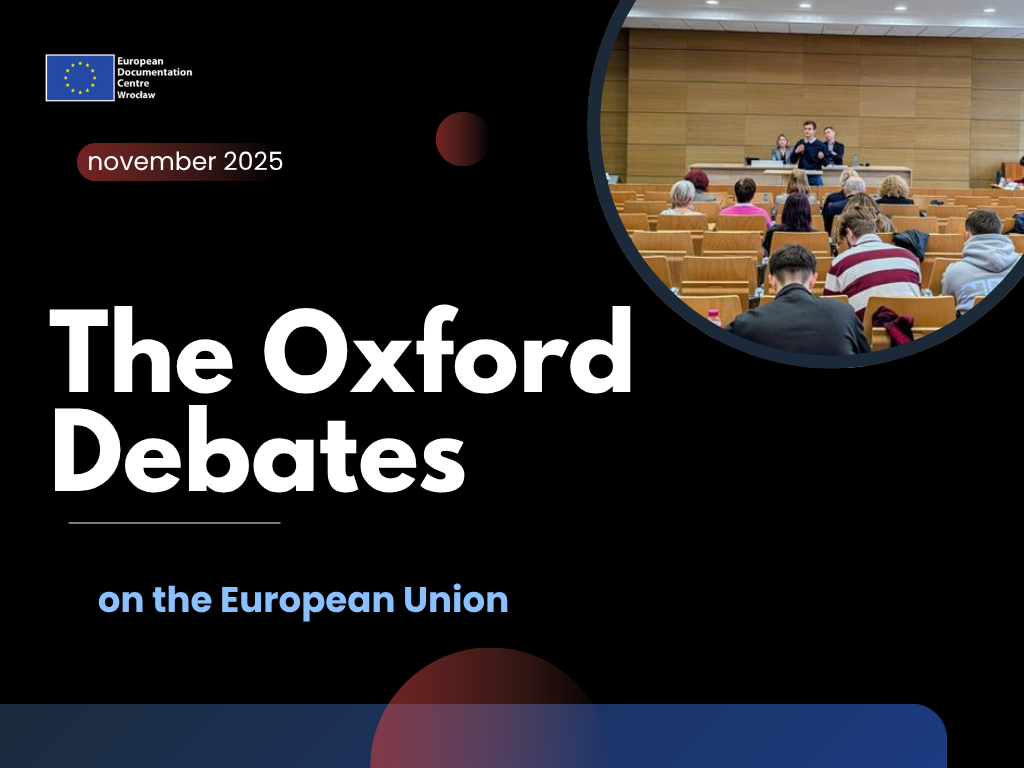
On November 3rd, the first in a series of Oxford debates organized by CDE and Team Europe Direct from the EU took place in Wrocław. Third-year Economics students engaged in lively discussions on the following topics:
“Fiscal incentives for remote and hybrid work bring social benefits that outweigh the fiscal costs.”
“A ban on planned obsolescence and enforcing the ‘right to repair’ are necessary for efficient and sustainable consumption.”
In a substantive presentation of their respective opinions, both sides used compelling arguments supported by data and reports. The jury’s scores were very close!
November 6, 2025, 9:35-11:15 a.m.
- Automation incentives should be contingent on maintaining and/or increasing employment and wage growth.
- Implementing a 4-day workweek (with the same wage) improves well-being and the net productivity of the economy.
November 17, 2025, 11:30 a.m. – 1:55 p.m.
- A special tax on AI-based activities is justified as a source of funding for retraining and mitigating the effects of automation.
- Renationalization of selected strategic sectors increases economic resilience more than market-based alternatives.
- Controlled economic immigration is necessary to offset unfavorable demographics and skill shortages.
November 20, 2025, 9:35-11:15 a.m.
- An unconditional basic income (UBI) is a necessity in an economy dominated by automation.
- A digital tax for “big tech” should be introduced to ensure neutrality.
November 24, 2025, 11:30 a.m. – 1:55 p.m.
- A complete ban on lobbying should be replaced by a regime of full transparency and a ‘cooling-off’, not by restrictions on contact.
- Gradually shifting the burden of pensions to funded pillars will increase the long-term stability of the system.
We cordially invite you to the next debates, which will take place in room 214 A.